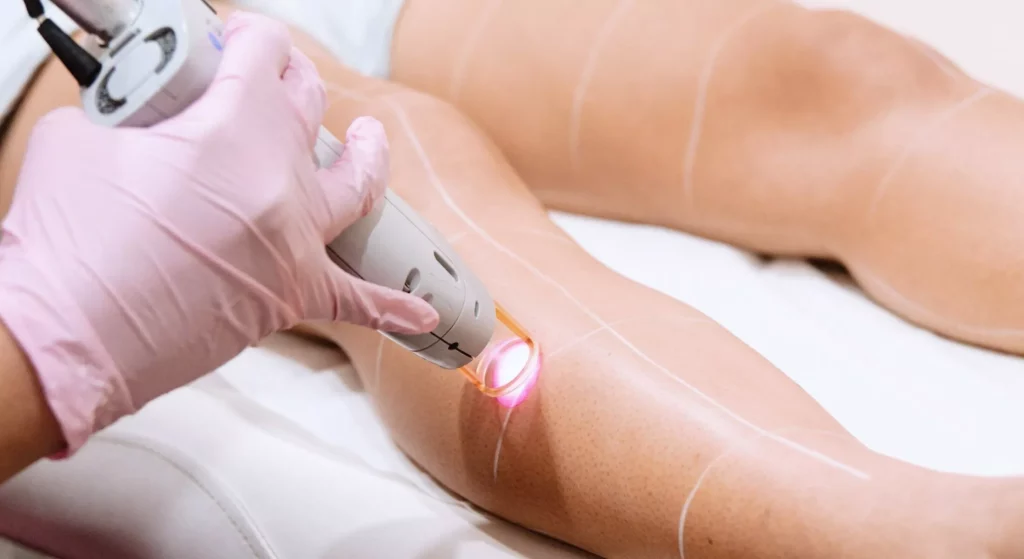
Six sessions? Eight? Twelve? A number quoted over the phone, before anyone has seen your skin, is not worth much. Here is what actually determines it — and why two people who come in for the same area sometimes leave with very different plans.
Why one session is never enough
The laser only destroys a hair while it is in its growth phase. This is the anagen phase: the hair is still connected to its root, it is full of melanin, and the laser energy can therefore travel down to the bulb and neutralise it.
The catch is that your hairs do not all grow at the same time. At any given moment, only a share of them is in the growth phase — the proportion varies from one area of the body to another. The rest are either resting or falling out, and on those the laser has no grip at all, however well it is set.
That is the whole logic of a protocol: we come back at regular intervals to catch each hair at the moment it is vulnerable. It is not a question of machine power, but of biology.
The ranges we see at Epilsoft
Based on what we observe in Uccle, Etterbeek and Watermael-Boitsfort:
- On the body — underarms, bikini, legs, arms, back, chest: generally 6 to 8 sessions.
- On the face and beard: closer to 8 to 10 sessions, followed by maintenance sessions.
That difference is not accidental. The face and neck are hormone-dependent areas: hair growth there is directly influenced by hormones, which can reactivate follicles over the years. You get a very clear reduction, but it needs maintaining — an occasional session, not a whole new protocol.
What makes the number vary
The colour and thickness of the hair
The laser targets melanin. A dark, thick hair absorbs a lot of energy: it responds quickly, often from the very first sessions. A light, red or very fine hair contains little of it: the result is slower and more partial. This is factor number one, ahead even of the area treated.
Your phototype
The sharper the contrast between skin and hair, the more direct the treatment. On dark skin we do not work with the same device: we use the Nd:YAG, whose wavelength passes through the epidermis without lingering on the melanin in the skin. The number of sessions stays comparable, but the settings and the pace differ. We cover this in detail in our article on laser hair removal on dark skin.
The area
An underarm, with its dense dark hair, responds faster than fine forearm down. Underarms and bikini are among the most satisfying areas; the face calls for more patience.
Your hormonal context
Polycystic ovary syndrome, a pregnancy, menopause or certain treatments can stimulate hair growth while the protocol is under way. That does not make the laser ineffective, but it changes the goal: we then talk about lasting control rather than permanent disappearance.
Your regularity
This is the most underestimated factor, and the only one entirely in your hands. Leaving four months between sessions instead of two means letting whole cycles restart. Protocols that drag on are almost always irregular protocols.
How often should you come back?
In practice we space sessions 6 to 8 weeks apart on the body and 4 to 6 weeks on the face, where the cycle is shorter. The interval naturally lengthens towards the end of a protocol, when fewer hairs remain to treat.
Between sessions you can shave as much as you like. What is off limits is wax, tweezers and epilators: those pull the hair out with its root, and the laser is then left without a target.
When do the first results show?
Usually from the second or third session: regrowth is slower, finer, sparser. It is a gradual thinning, not an overnight switch. People who give up after a single session miss the essential part.
In the days after a session it is normal to see hairs that seem to be “growing back”: these are in fact treated hairs that the skin is pushing out. They fall on their own.
Why we do not quote a number over the phone
Announcing “6 sessions” to someone whose skin and hair we have never seen means selling a number, not a result. Two people with the same request can need very different protocols.
That is why the first appointment is an assessment, and it is free. We look at your skin, determine your phototype, assess the density and colour of the hair on the area concerned, check for contraindications — and only then give you a realistic number of sessions, with the matching price. No commitment.
You can look at our prices by area to get a first idea, and book online at whichever centre suits you: Uccle, Etterbeek or Watermael-Boitsfort.