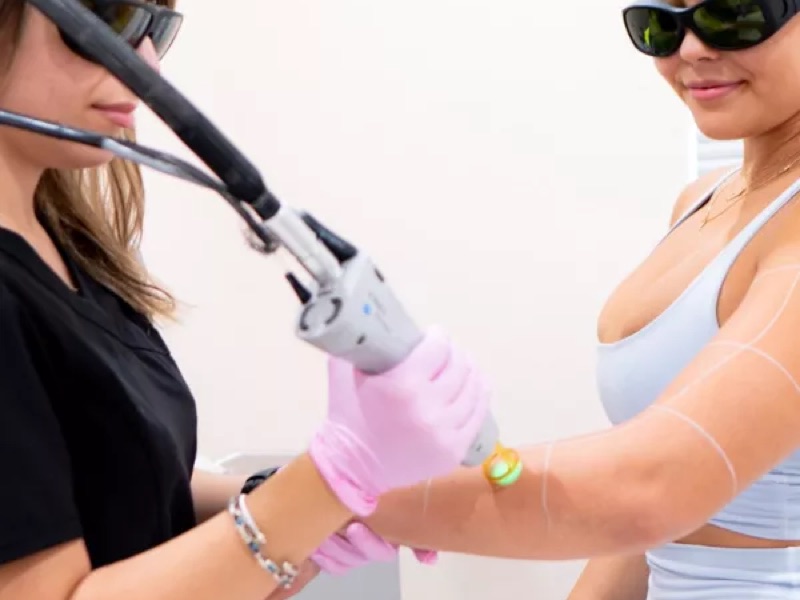

Some of our clients come in with hair growth that has changed: denser on the face, appearing on the stomach or chest, often within a few months. Behind it there is frequently a hormonal context. The laser keeps all its value in these situations, provided we are clear about what it can do.
One thing first: we are a hair removal centre, not a medical practice. What follows is meant to help you understand, never to replace the advice of your doctor or gynaecologist. If your hair growth has changed rapidly, theirs is the first appointment to make, not ours.
Why hormones change hair growth
Some follicles — face, neck, chest, stomach, lower back — are sensitive to androgens. When the hormonal balance shifts, these follicles can turn fine, light down into thick, pigmented hair. This is known as terminalisation.
That mechanism explains why the face and neck almost always need more sessions than legs or underarms: on those areas new follicles can be recruited over time, while the protocol is already under way.
Polycystic ovary syndrome (PCOS)
This is the hormonal context we encounter most often. Hair growth typically settles on the chin, upper lip, neck, the line of the stomach and sometimes the chest.
Does the laser work? Yes. The hair is generally thick and dark, so it is well targeted. The reduction in density is clear and daily comfort changes a great deal — many of our clients mention above all no longer having to check themselves several times a day.
What you should know: as long as the hormonal cause remains active, new follicles can wake up. So we do not talk about permanent disappearance but about lasting control: a longer initial protocol — often 8 to 10 sessions on the face — then maintenance sessions spaced further apart.
Two pieces of advice: have the medical side followed in parallel, because well-managed hormonal treatment makes the laser more effective; and do not wait until hair growth is well established, as results are better when things are taken in hand early.
Pregnancy and breastfeeding
There is no study showing a risk from hair removal lasers during pregnancy. But neither is there a study showing the absence of risk, and as a matter of precaution we do not treat pregnant women.
There is also a practical reason: pregnancy brings hormonal upheaval and changes in pigmentation (melasma in particular), which make the skin less predictable and the settings less reliable. A protocol started before pregnancy is simply paused: nothing is lost, we pick it up afterwards.
After the birth we generally wait for things to settle — and if you are breastfeeding, speak to your doctor before resuming.
Menopause and perimenopause
Falling oestrogen changes the balance with androgens. A frequent result: hair that thins on the body but settles on the face, particularly the chin and upper lip.
The laser is very relevant here, with one limit that must be named: white or grey hair does not respond to any laser. It no longer contains melanin, so there is no target. On mixed hair we effectively treat what is still pigmented; for the rest, only electrolysis is an option — we do not practise it, and we will tell you rather than have you start a protocol that will not deliver what you hope for. We compare the three technologies in this article.
That is a concrete argument for not waiting too long: the window in which hair is still dark is the window in which the laser is effective.
Other situations to mention at the assessment
- Hormonal treatments, contraception, fertility treatment, gender transition: nothing prohibitive, but it changes the outlook and the pace.
- Long-term corticosteroids, which can stimulate hair growth.
- Photosensitising medication — some antibiotics, anti-inflammatories, antidepressants, acne treatments. Those sometimes mean postponing.
- Thyroid disorders and adrenal conditions.
None of these is an automatic reason to refuse treatment. What matters is that we know about them before setting the device.
What we will tell you at the assessment
Honestly: if your hair growth is hormonal, we will talk about control rather than disappearance, we will quote a higher number of sessions, and we will warn you that maintenance will be needed. That sells less well than a promise of permanence, but it matches reality — and it is why people come back.
The first appointment is free and without commitment, in Uccle, Etterbeek or Watermael-Boitsfort. Book an appointment · See our prices