“I have a tattoo, so I suppose that rules it out?” No. It is in fact one of the easiest questions to settle, once you grasp a simple rule: the laser targets anything dark. It does not distinguish between a hair, a mole and ink.
Tattoos: we always work around them
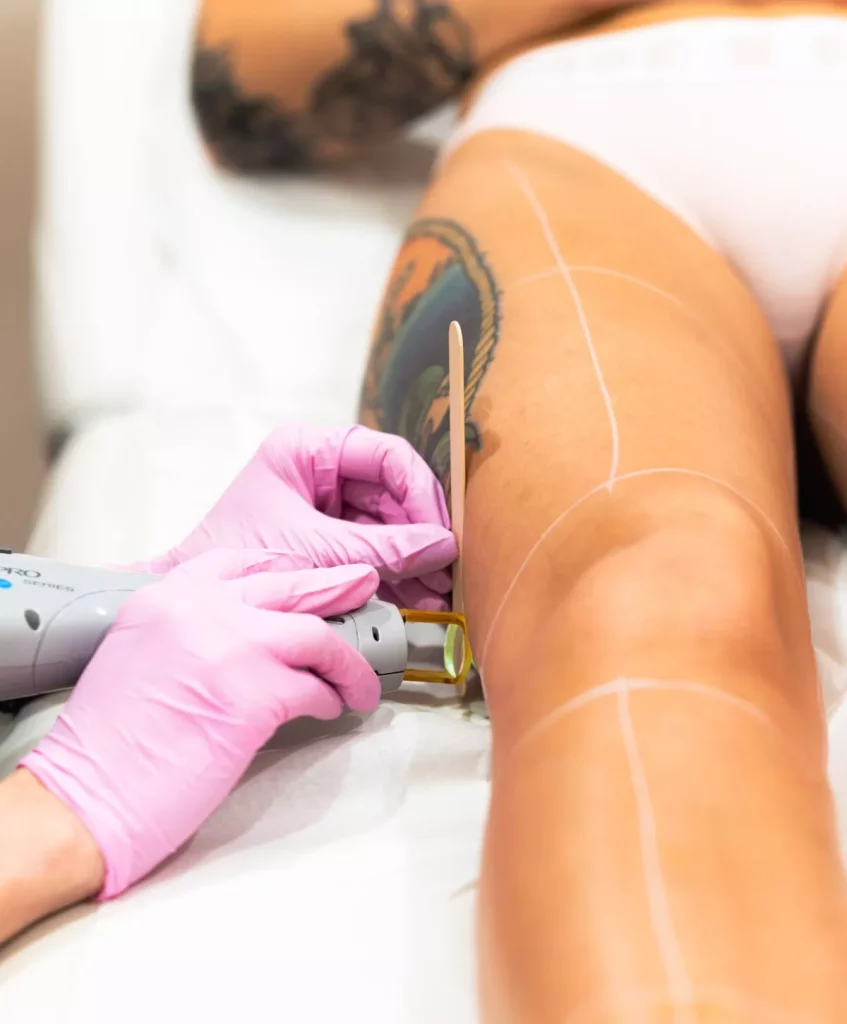
A tattoo is made of pigments concentrated in the dermis. Those pigments absorb the energy of a hair removal laser massively and uncontrollably. Fire on it and the result is an almost certain burn, a blister, a possible scar, and a damaged tattoo — colours turn, outlines bleed.
Our rule is absolute: we never go over a tattoo. No setting makes that safe, and no serious centre will suggest otherwise.
What we do in practice: we cover the tattoo — with a white patch or a dermographic pencil outlining it — and treat all around it, leaving a safety margin of a few millimetres. On a tattooed calf, that means the leg is treated normally and a hairy patch the size of the tattoo remains.
Does that mean giving up? Almost never. Most tattoos are small enough for the overall result to remain very satisfying. On a large tattoo covering a whole back or forearm, however, we will tell you frankly at the assessment: the gain will be partial.
Moles: we work around them too
Same logic. A mole is a concentration of melanin, exactly what the laser is looking for. Firing on it risks a burn — and, above all, changing its appearance, which then interferes with dermatological monitoring.
We spot them at the start of the session, mark them if necessary, and go around. Small freckles do not pose the same problem: they are superficial and diffuse, and do not require working around.
One important point: if a mole has recently changed shape, colour or size, we will ask you to have it seen by a dermatologist before treating the area. That is not excessive caution: we are not doctors, and a laser has no business near an unidentified lesion.
Scars: it depends which
An old, flat, white scar is generally not a problem: it contains little melanin, we can treat around it and often over it, with careful settings.
We do avoid:
- Recent scars, still pink or red — the skin is still rebuilding.
- Keloid or hypertrophic scars, which show a tendency to over-heal. The laser can restart the process.
- Graft sites or old burns, unless a doctor advises otherwise.
If you have a known tendency to keloids, say so at the assessment. We will test a small area before going further.
Permanent make-up and microblading
Same rule as a tattoo: these are pigments. We do not go near a microbladed eyebrow or a permanent eyeliner. On the face, that simply means defining the limits carefully before starting.
And piercings?
We will ask you to remove metal jewellery on or right beside the treated area. Metal reflects and conducts heat. If a piercing cannot be removed, we go around it.
What it changes for your appointment
Nothing, except two extra minutes at the start of the first session to spot and mark what must be avoided. It is also one of the reasons we look at the skin before quoting: two backs identical on paper can require very different work.
Tell us about tattoos, monitored moles, scars and dermatological history at the assessment. It is free and without commitment, in Uccle, Etterbeek or Watermael-Boitsfort.
Book an appointment · See the contraindications