Nobody will tell you that laser hair removal cannot be felt. That would be untrue, and you would find out at the first pulse. What is true is that the sensation is brief, that it is very different from waxing, and that much of what you feel depends on things we can act on.
What it feels like, concretely
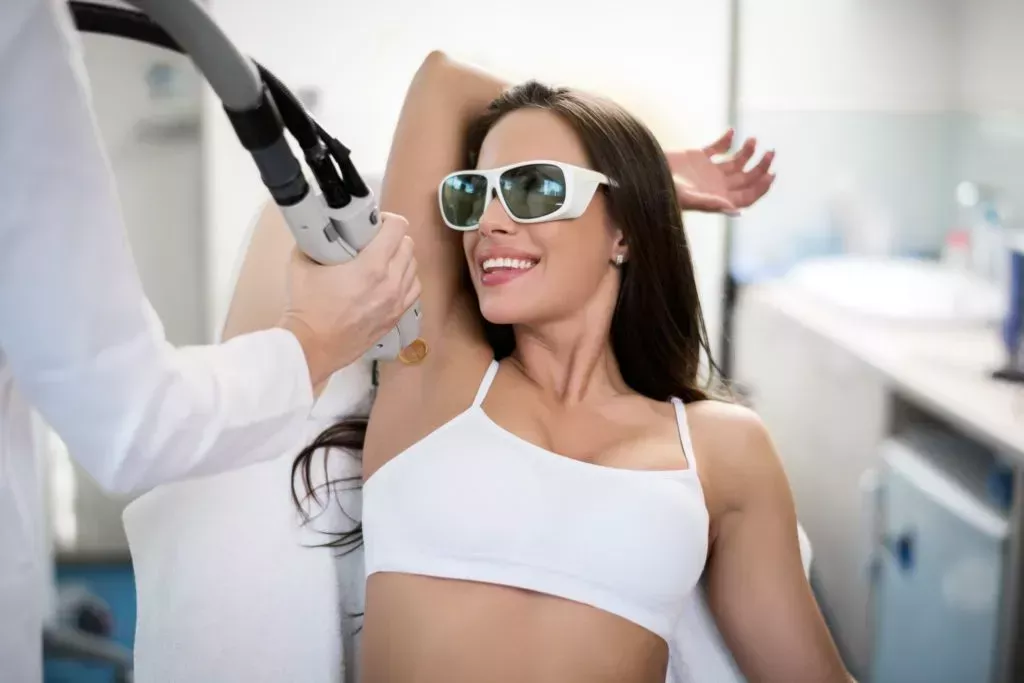
The description our clients give most often: an elastic band snapped against the skin, followed by a brief sensation of heat. The pulse lasts a few milliseconds. It is not continuous pain: it is a series of small peaks, one per shot.
Our Candela lasers include a cooling system that blows cold onto the skin at the very moment of the pulse. That is what changes comfort most: the heat is absorbed by the hair, while the surface of the skin stays protected.
The comparison with waxing is clear-cut, and it is the one most people make: wax rips a whole strip at once, while the laser stings briefly, point by point.
It depends above all on the area
There is not one sensation, there are as many as there are areas.
- Well tolerated: legs, arms, back. The skin is thicker and the hair less dense than elsewhere.
- More sensitive: underarms and bikini. Thin skin, dense dark hair, plenty of nerve endings. The good news: these are also the quickest areas — a few minutes at most.
- Particular: the face, where you mostly feel vibration near the bone, and the male chest, where very dense hair concentrates a lot of energy.
What really changes comfort
The point in your cycle
In the days before a period, sensitivity is markedly higher. If you can pick the date, avoid that window — especially for a bikini.
The shave the day before
Hair left too long burns at the surface instead of conducting energy down to the bulb. That is unpleasant and less effective. A clean shave the day before genuinely changes how it feels.
Coffee
A coffee just before a session increases pain perception. This is not clinic folklore: better to have it afterwards.
The first sessions are the strongest
That is logical: there is the most hair, so the most energy absorbed. From the third or fourth session, density has dropped and sessions become noticeably more comfortable. Many clients barely register some areas by the end of a protocol.
Saying so
This is the most important point, and the most neglected. If an area stings too much, say so during the session. We can adjust fluence, slow down, work differently. Gritting your teeth in silence does not make the treatment more effective — it just stops us doing our job properly.
What about numbing cream?
It exists, you can buy it at a pharmacy, and it is applied a good hour beforehand under film. We do not recommend it as a matter of course, for two reasons.
First because it is rarely necessary: the vast majority of people manage perfectly well without. Second because it removes the warning signal: if your skin can no longer tell you a setting is too strong, we lose a useful reference. If you are very sensitive or very anxious, raise it at the assessment and we will look at it together — it is not forbidden, it is simply a case-by-case decision.
After the session
The residual sensation is like mild sunburn for a few hours. Nothing that stops you getting on with your day. We set out what follows in our article on what is normal after a session.
The best way to know: try
Pain tolerance is very personal, and no article will replace your own experience. At the first appointment, which is a free assessment, we can fire a few test pulses on the area that worries you. You will know within thirty seconds, without having committed to anything.
Uccle, Etterbeek, Watermael-Boitsfort: book an appointment or look at our prices first.